Approved data. Connected templates. Auditable output.
Content Central is RightMarket's cascading data layer. Approved messaging, location data, regulator-mandated wording, and campaign content live in centralised databases that propagate to every linked template — automatically.
Configured once by your admin. Propagated everywhere. Audit-trailed end-to-end.
The data problem every distributed brand faces
Across NFP, franchise networks, federation bodies, and multi-campus education institutions, the same data failure shows up.
Approved data lives in too many places at once
The brand guidelines say one thing. The CRM says another. The shared drive has the version from last quarter. The hiring manager's saved template has the version from three quarters ago. Nobody knows which is current — including the people creating new assets.
When data changes, nobody updates everything
Pricing changes. Opening hours change. Charity registration wording changes. The fundraising campaign hits a new total. Updating every linked asset manually is impossible at network scale — so most assets carry stale data the moment they're published.
Manual entry is where compliance gaps appear
When a hiring manager types in the role qualifications, the volunteer coordinator types in the charity number, the franchisee types in their opening hours — each one is a manual-entry opportunity for the data to be wrong, outdated, or off-brand.
"Show me the version that was approved" has no answer
When a regulator, trustee, or board asks "prove that your assets carried the correct statutory wording on this date", most organisations have to reconstruct the answer from version-controlled brand books, email threads, and people's memories.
Content Central makes the approved data the only data — and logs every version of it.
See how it works →How Content Central actually works
Content Central isn't a content library. It's a structured database layer that sits underneath every template, auto-populating approved fields and propagating updates the moment they're made.
Centralised databases by data type
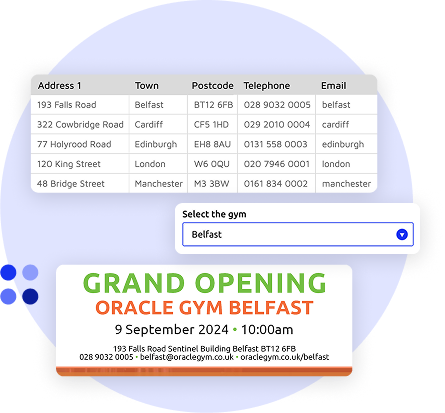
Admins create databases for the data your organisation uses repeatedly: location records, role-type records, campaign records, partnership records, statutory-wording records. Each database has structured fields — name, address, opening hours, registration number — fully under admin control.
Profile-based auto-population
When a user opens a template, Content Central reads their profile and auto-populates the linked fields. A franchisee in Manchester sees the Manchester address. A hiring manager selects "Senior Programme Manager" and the role qualifications auto-populate. No manual entry; no version confusion.
One update, every linked asset
When you update a record in Content Central, every template linked to that record reflects the change immediately. Opening hours change for one unit — that unit's marketing updates everywhere it appears. New charity registration wording approved — every asset carries the new version on next open.
Cascading and conditional logic
Selecting one value can drive the population of multiple related fields. Choose "Glasgow campus" and the address, phone, accessibility statement, and registrar contact all populate together. Choose "Fundraising — Children's Services" and the appropriate beneficiary stats and disclosures populate together.
ToVA synergy and approval bypass
Because Content Central fields are pre-approved, content composed from CC records bypasses much of the language-validation overhead. Designs using 100% Content Central data can skip certain approval stages — the data was approved when the record was created.
Full audit trail by data version
Every Content Central record carries a version history. Who created it, who approved it, when it changed, what it was before. When a regulator asks "what wording was in use on 23 April?", the answer is in the audit log.
Where Content Central earns its keep
See how different roles and sectors use Content Central to maintain compliance and brand consistency.
Network-Wide Data Consistency
Local data, centrally governed
Statutory Wording and Charity Compliance
Right phrase, every asset, every time
Live Campaign Data
Stats that age out, kept current
Role-Type Databases
Job descriptions that build themselves from approved components
Multi-Campus and Multi-Faculty Data
Right campus, right course, right regulator-mandated phrase
Co-Branded Partnership Data
Partner data managed centrally, deployed cleanly
How Content Central fits with the rest of the platform
Content Central is the data layer. The rest of RightMarket enforces what sits in it.
Tone of Voice Assistant
CC fields are pre-approved at the record level, so they bypass ToVA validation. Freeform text fields are still ToVA-validated. The combination: most content auto-populates from approved data, the rest gets screened.
Brand Governance / Design Assistant
CC powers the cascading dropdowns and dynamic field logic in locked templates. A franchisee selects their location once; every relevant field populates from that single CC record.
Image Security
CC records can reference DAM asset IDs — so when a partner logo is updated in your DAM, every co-branded template reflects it. Consent metadata carries through.
Approvals
Designs composed from 100% Content Central data can bypass standard approval routing. The data was approved when the record was approved; the design is automatically compliant.
Compliance Automation
CC's version-controlled audit trail is what makes "which approved version of which wording was in use on which date" answerable.
Who Content Central is for
Content Central is built for organisations where:
-
The same data appears in many assets — addresses, statutory wording, role descriptions, campaign data, partnership terms
-
That data changes often, or unpredictably — pricing, opening hours, regulator-mandated phrases, campaign totals
-
A central function is accountable for accuracy — brand, HR, compliance, fundraising, or franchisor HQ
-
Proving you got it right matters — Charity Commission, OfS, FCA, franchisor liability, donor trust, regulator audit
That's:
NFPs
with statutory compliance overhead
Franchise HQs
with network-wide data consistency requirements
Federations
governing member output
Education institutions
with multi-campus or multi-faculty data
If your messaging changes rarely and your network is small, manual updates may be enough. Content Central is the data layer for organisations where many people publish, the data changes often, and proving you got it right is non-negotiable.